
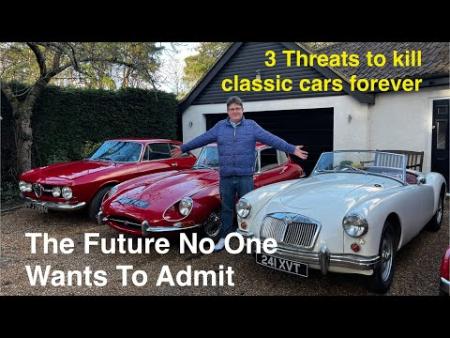
In order to fully grasp the scope of these remarks in case you were insensitive to that specialised form of art, freedom and soul called classsic motoring, just substitute "classic cars" here with "art, soul and freedom" themselves:
The Future of Classic Cars – 3 Big Threats That Could Kill Classics Forever
by RC Classic Garage:
The RC Classic Garage YouTube channel
RC Classic Garage on Instagram
Transcript:
So are classic cars on borrowed time between government regulations fuel availability and the next generation that might not care the future of classic cars looks uncertain.
My last video on the future of classic car values sparked a lot of comments about the future of classic cars altogether, so today I thought I'll break down the three biggest threats to the future of classic cars and then tell you at the end where I think all hope is not being lost.
First up is government regulations: as the world pushes for greener solutions, classic cars become an easy target. Take ultra low emission zones or UL zones: cities like Paris, London, Berlin are expanding these zones, making it difficult to drive classic cars, and unless your classic cars are classified as historics it becomes very expensive to drive them, or in some cities banned outright. And then there's the big one: the planned ban on petrol and diesel engines sold in all new cars post 2035; what will happen to our classic cars and millions of cars on the road post 2035? Will these eventually phase out, or will we be forced into electric conversions? The irony? Classic cars are barely on the road compared to modern cars, so the environmental impact is actually tiny. But I suppose try and explain that to a bureaucrat.
And the second major threat: fuel availability. As we push to the adoption of EVS, petrol stations are likely to convert the area into EV chargers, and thus reducing fuel supply. I mean, already fuel is becoming a challenge; take E10 for example: it's great for modern cars but it's a nightmare for these Classics. It corrodes the tanks, damages rubber hoses and damages your carburettors. Now, sure we can use additives and upgrade fuel lines, but what if petrol in itself became rare and expensive, say £10 a liter? I know it sounds almost insane, but look at paraffin: once a common household liquid used for heaters and lamps, now almost extinct. What happens if petrol follows same suit due to electric conversion?
The third threat is the next generation, and this might be the biggest threat of all, because who is going to love these classic cars when we are gone? Young people view these cars as old, noisy, unreliable; they don't have Bluetooth, they don't have autopilot. Now, when I was young I used to dream of classic cars; younger generations don't dream of classic cars, they dream of a metaverse. And then there's also the cost: insurance is expensive, maintenance is costly, classic car prices are sky high, pricing the younger generation out of the market. But there's also skills: younger generation aren't learning the skills of working on the cars and tinkering on them, and this may be lost in future generations on how to keep these Classics on the road.
Okay now that's a lot of doom and gloom. But let's take take the E-type for a drive and I'm going to tell you why I don't think classic cars are finished just yet.
First of all the future of EV is not as certain as everybody first predicted. While the move towards EV is happening it's not as straightforward as first predicted. You know, I'll go through some of the issues with that. The lack of EV charging infrastructure: most countries still lack the infrastructure needed for the widespread adoption of EV charges. And then we have the electricity generation challenges: shifting millions of cars to electricity requires a massive increase in electricity generation, and many infrastructures around the world just can't cope already. So there will be a big infrastructure challenge. And then car companies are backing out of EV only futures: companies like Porsche, Ford, Toyota have all announced that they are rethinking the EV strategy; a lot of them have announced that they will be investing back into combustion engines. And this change by the manufacturers is driven by consumer hesitancy; costs and infrastructure challenges are driving them to think of a more balanced future. So the future of EVS is more complicated than we originally thought. Now, I think we're going to see a mix of EVS, hybrids and alternative fuels rather than a complete petrol car engine ban.
And then that brings us nicely onto the second threat: future fuels. Now, synthetic fuels are being developed and these synthetic fuels are carbon neutral, classic friendly, and there are a lot of people investing in them: Porsche, Ferrari, even Formula 1, so they're definitely being developed as a carbon neutral fuel option for the future.
And for the third threat, enthusiast groups are thriving: events like Goodwood Revival are bigger than ever, car communities are thriving, and younger people are turning up at car meets. Young petrol heads do exist. I recently went to a car meet that was organized by a group of twenty-something year olds, and the event was thriving. I know this may be the exception to the rule, but I think they are just that: exceptions. Because as generations move on, they don't have the same nostalgic value for the car, and this still remains the bigger threat. Take 30s and 40s cars: demand has declined, values have declined and as I said in my last video same will happen to 50s and 60s cars, and eventually the new generation who have no nostalgic value towards 80s and 90s cars will feel the same. So I still think the newer generation and nostalgic value towards cars remains the biggest threat for class cars going forward.
But it's up to us, the current custodians of these cars, to make sure that they remain relevant and exciting. To me, this means sharing our knowledge, sharing our skills, making sure we take the cars out to as many meets as we can, taking people for rides. It's one of the reasons I started this YouTube channel: to show to people the classic car experience of owning a selection of classic cars, what it means to fix them, maintain them, and use them.
Whenever I go to a classic car show and I see a kid looking at the car and looking in, I open the door, I allow his parent to take a picture of him or her inside the car because I just hope that that is a moment that sparks it for that kid in the car. I was once a kid that dreamed of owning these type of cars, and there was a moment when someone let me sit in their Ferrari that sparked that moment for me, and I just hope that we can continue to spark that moment in future generations.
So, am I worried about these threats? Well, yes, a little, because I do think there'll be changes in regulations, changes in fuel, but I don't think those will be enough to make our classic car hobby disappear. Te threat lies in the future generations adoption of our hobby, and that threat lies over the next 20 to 30 years.
So will I be selling any of my collection? Well, not a chance. Because we really don't know what the future holds. Maybe these classics will turn into Museum pieces or dust collectors, but if that's the case well let's get out now, enjoy them, use them, drive them, take them to as many events as we can, share them and hopefully show future generations why they're worth saving.
They've survived wars, recessions and even bad paint jobs; these cars have soul and history and a way of connecting people like no other. Some of my best friends have been made through cars, so let's hope they don't disappear like the horse drawn carriage.
But what do you think? What is the biggest threat to classic cars going forward? Please let me know in the comments below. Thanks again for watching another episode of RC classic garage. Please don't forget to like and subscribe. This channel is all about ownership experience, where I share my classic car ownership with you guys on YouTube. Thanks again for watching, and see you all next time.